A verdict tells you where you stand. It doesn't show you why.
Building a high-performance team moves in three stages. First, each person understands themselves — their natural strengths, their blind spots, what they do under pressure. Then you understand each other — not as roles, but as people with distinct patterns. The Grid is the third stage: the whole picture of how your team is actually shaped, and where the tension lives before it becomes a problem.
Knowing you're a B-team doesn't tell you which two people are quietly grinding against each other, why the new hire isn't landing, or which strength your team is missing entirely. For that you need to see the shape — not a score.
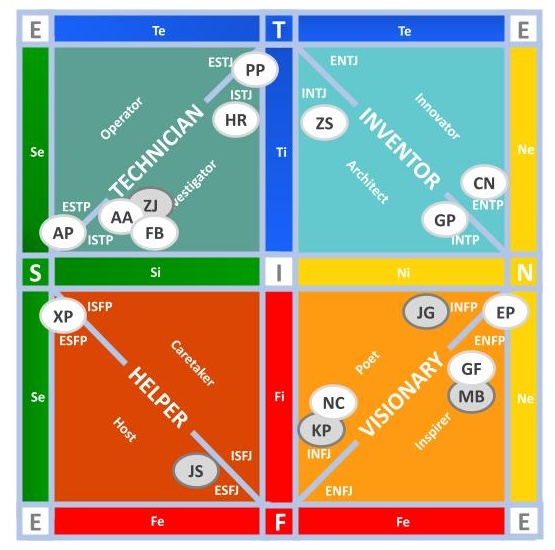
The Polarity Team Grid is what the name says: an overview of your team's polarities. Not a personality quiz result — a working map of who's where, what's represented, what's missing, and where the tension actually lives.
What it shows you — free, for your whole team.
- Who carries which strengths
- Which strengths are missing or overrepresented
- Where tension is predictable — before it becomes conflict
Send one link. Everyone completes a free, 15-minute Type Explorer and gets their own Polarity Profile — no accounts required. Individual profiles roll up into the Grid automatically.
"The Polarity Team Grid helps me see the hidden architecture of my team — each person's natural strengths and contribution. It makes it easier to get the right people in the right seats."
— Patrick Pitman
What your team actually sees.
A working map, not a personality quiz result — who's carrying what, and where the team is stronger than any one person on it. Here's a real one. Team of eleven, names changed, results unedited.
Built for the moments that actually cost you something.
A new hire isn't landing.
Someone capable on paper is struggling to find their footing. The Grid shows whether it's a fit problem or a formation problem — and what to change either way.
Leadership isn't aligned.
Everyone agrees in the room and disagrees in practice. The Grid surfaces where the disagreement actually lives — usually not where anyone thought to look.
Growth is outpacing structure.
The team that got you here isn't automatically the team that gets you there. The Grid shows what the next phase actually needs, before you're improvising under pressure.
Two strong people can't work together.
Both are right. Both are frustrated. The Grid explains why — the same spiral you'd expect when two opposing polarities meet under pressure.
A remote team, and burnout you can't see coming.
Remote work hides what used to be visible in a room — who's leaning in, who's quietly checking out. The Grid surfaces energy patterns other tools miss, before burnout costs you the person.
"The remote work environment asks more perception of people's energy — where do they lean in and thrive, when do they back off or lag behind? John's analysis explains why, and helps us prevent burnout and low performance."
— Patrick Pitman
You've seen who you are. Now see how you're actually working together.
The Grid shows your team's shape — who carries what, where tension is predictable. The next act is measuring how that shape is actually performing: the Polarity Team Effectiveness Scan, the pro version of the free Team Diagnostic.
Your whole team answers 34 statements across 9 dimensions — where you are today versus where you want to be. Then a guided debrief turns the results into one focus and a concrete action plan. Run it again next quarter and you're watching a trend, not a snapshot.
See what the Scan includes"He helped us understand ourselves — and each other. We've never been more productive."
— Matt Hinsley, CEO
See your team's shape, free.
Start with a free, 15-minute Type Explorer for each person on your team.
Start Your Team's Free Type Explorer