Every team moves through four stages — and most get stuck before the top.
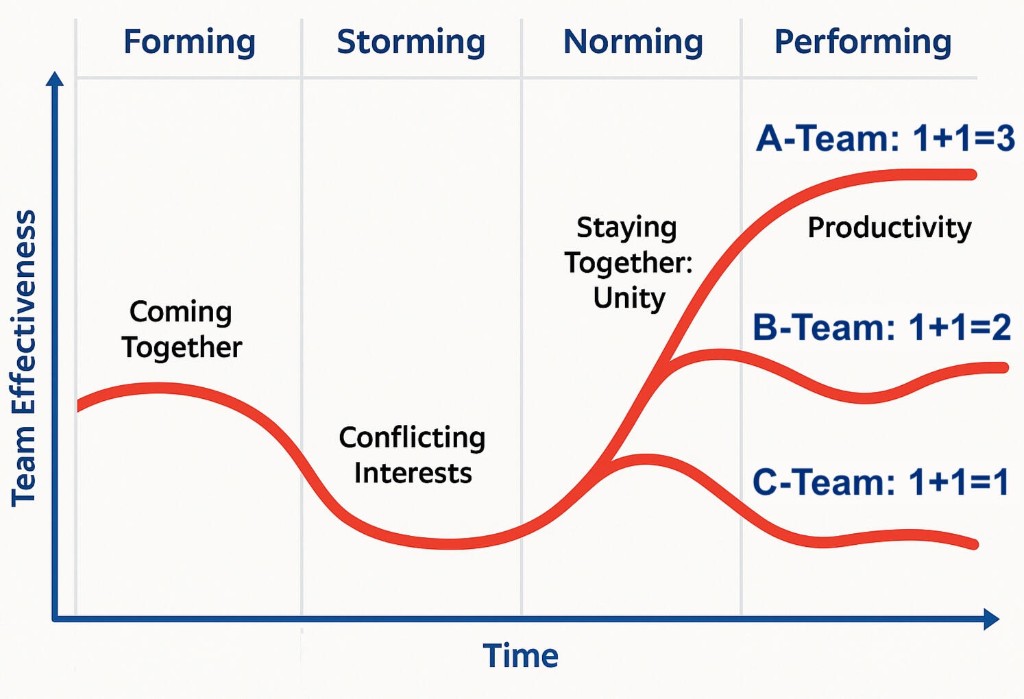
Three Types of Teams
Every team passes through four natural stages: Forming, Storming, Norming and Performing.
But not every team makes it to the top. In fact, most teams settle — or slip.
-
A-Teams: Synergy in Action
These teams outperform expectations. With 1+1=3 energy, their chemistry, they generate results no individual could achieve alone.
-
B-Teams: Functional, but Flat
They meet the brief, but not much more. They do the job. No breakthroughs, no real synergy. 1+1=2.
-
C-Teams: Stalled or Sliding
Friction, fatigue, or quiet dysfunction hold them back. These teams operate below their potential. Sometimes, 1+1<1.
Most teams settle in the middle. Understanding why starts with Storming.
Storming and Norming are the two phases that decide everything.
Storming is where the natural tension between opposing strengths surfaces. Without a unified center — no agreed principles or goals — that tension turns into conflict instead of energy. The longer a team stays there, the higher the cost.
Norming is how a team resolves it. Not by picking a side, but by building a Team Charter — the values, goals, and standards everyone actually agrees to. The charter is what lets opposing strengths hold together instead of pulling apart.
"John helped us go from no direction to full alignment in 2 days."
— Cor Honkoop, General Manager
Under pressure, every strength meets its opposite.
Most personality tools measure who you are on a good day. They ask a set of questions, sort your answers, and hand you a label. The label is usually accurate. It's also usually incomplete, because it only describes you at rest.
People don't work at rest. They work under deadlines, in rooms with people who think differently than they do, on days when the plan changes twice before lunch. That's when the second half of the picture shows up — the opposite pull that was always there, just quieter. This is the polarity principle: every strong orientation has a natural counterpart, and the tension between them isn't a flaw to fix. It's the mechanism underneath Storming.
Here's what makes it a team problem, not an individual one. Under pressure, a person's greatest strength can tip into its own shadow — the decisive leader turns impulsive, the steady operator turns rigid, the connector turns conflict-avoidant, the analyst turns cold. And what tips someone into their shadow is very often exactly what a teammate with the opposite strength can't stand. Their reaction, under the same pressure, is to lean harder into their own strength — which tips them into their own shadow — which is exactly what irritates the first person. Two people, both right, both under pressure, escalating each other simply by being more themselves.
That's what Storming actually looks like at the level of behavior. Not a personality clash. Polarities polarizing.
And Performing isn't a permanent state. It's a practice. New pressure, new stakes, a new hire, a leadership change — any of it can re-arm the spiral, even in a team that had it working. A nine-year study of engineering design teams (Wilde, 2008) found that typologically diverse, well-structured teams moved from a 27% award-winning rate to 73% — and fell back to 25% in the years the method wasn't consistently applied. The teams didn't get worse. The practice lapsed, and the polarities that had been consciously balanced went back to running unconsciously.
Why the tests you've already taken didn't quite land.
If you've taken a personality assessment before — MBTI, DISC, Insights Discovery — some of it probably felt true. That's not an accident. Most of these tools share a real foundation: they're built, directly or loosely, on Carl Jung's original work on psychological types.
What they inherited less well is the dynamism.
Jung's own framework was never meant to sort people into fixed boxes. He described type as a preference, not a cage — a tendency the mind returns to, not the only mode it has access to. Somewhere between Jung's original writing and the instruments built on top of it, the tension got flattened into a label.
MBTI, for instance, forces a binary choice on the J/P axis — judging or perceiving — where the honest answer for most people is "depends on the day, and depends on the stakes." That's why retest studies consistently find that a large share of people — some research puts it between 39% and 76% — get a different type when they retake the same assessment within weeks. The test isn't unreliable. The person didn't change. The tool just isn't built to see both sides of the same person.
Insights Discovery runs into a related problem: it drops the sensing/intuition axis, one of Jung's four core functions, in favor of a simpler four-color model. Simpler to teach, harder to use for anything that requires real precision — like understanding why two "green" people on the same team can be nothing alike.
None of this makes the underlying discovery wrong. It makes the implementation incomplete. The polarity principle is what those tools were reaching for and didn't quite build: not a replacement category, but the mechanism underneath the categories that were already there.
So the real question isn't "what's my type."
It's which polarities are in tension on your team right now — and where you are in the cycle. A label describes a person at rest. It won't show you the spiral, and it can't show you a team.
How you actually see it, in six steps.
Team Diagnostic — 5 minutes, free. Where you stand: an A, B, or C read on your team, today.
Type Explorer — 15 minutes each, free. Who each of you is: your own Polarity Profile, mapped from how you actually operate under pressure.
Polarity Team Grid — free. Why: every profile rolled into one picture of your team's polarities — who carries what, what's missing, where the tension lives.
Team Effectiveness Scan — $200/month per team. How you're actually doing: the pro version of the Diagnostic. Your whole team answers 34 statements across 9 dimensions — where you are today versus where you want to be, and the gaps that tell you what to work on first.
Guided Debrief — included. What to do: a structured team conversation over your own results, ending in one focus and a concrete action plan with owners and deadlines — so your polarities hold together instead of pulling apart.
Repeat Scan — included. Whether it's working: run the Scan again next quarter and see the trend, not the snapshot — because Performing is a practice, not a permanent state.
A framework with roots, not a trend.
The polarity principle draws on more than two decades of applied work — corporate teams, leadership groups, and elite sports teams, including the coaching engagement that produced Olympic gold in 2012. It's grounded in Jung's original typology, extended to account for what Jung himself pointed to but earlier instruments never fully operationalized: the dynamic tension between a person's dominant orientation and its counterpart.
Already familiar with polarity thinking, Ofman's Core Quadrants, or Jungian typology?
If you work with individuals or teams using a related framework, you don't need to be sold on the underlying idea. You need a tool that operationalizes it without asking you to become someone else's brand.
See the practitioner offer →See your team's polarities, not just its verdict.
The Diagnostic tells you where you stand. The Polarity Team Grid shows you why — who carries what, what's missing, where the tension actually lives.
See the Polarity Team Grid